Brand identity – the foundations of good brand communication
What is brand identity - and why does it determine the success of your brand communication?
Brand identity is the “soul” of your brand: the internal image that you define and consistently live by. It ensures that your brand is recognizable and reliable in terms of language, appearance and performance. Without a clear identity, communication becomes arbitrary, differentiation is lost and customers cannot develop a stable reason to trust you or recommend you to others.
The task of brand identity is to show through communication what emotion can be associated with the company and its services / products.
We remember from the previous blog: Customers choose what gives them an emotional added value. This requires a complete Brand Experience.
People don't buy what you sell, but WHY you sell it."
Brand identity - the soul of your brand
The core of a company’s identity lies in the value it offers its customers.
And customers want to “feel” the emotional added value that a corporate brand brings them. This is because the emotional added value has the effect of strengthening their own positioning, identification, orientation and prestige.
The archetype defined in advance (see our blog “More success in sales with the right brand positioning”) serves as the starting point for the brand identity and thus for the emotional added value that is to be conveyed to customers in communication.
The brand identity itself defines how the brand is to affect its target groups, which values are to be conveyed and which emotions are to be triggered. It provides a complete brand experience together with the archetype.
The 4 elements of brand identity
Brand identity can be divided into four elements. Each element is important in itself, but only together do they create a sustainable identity.
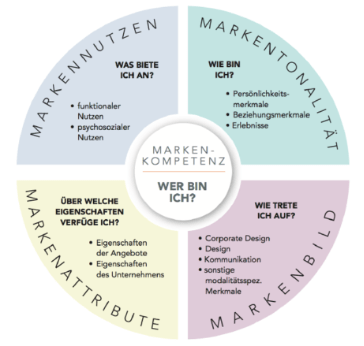

Brand tonality - what am I like?
Brand tonality refers to three categories and is essential for the target group-oriented communication strategy:
1. it expresses personality-related characteristics of the brand.
2. it describes the behavior of the brand in relationships with customers.
3. it defines the brand wording – the approach to the target group – depending on the archetype from the brand positioning.
Typical tonality modules:
Language style: factual, empathetic, humorous, provocative, sober, inspiring.
Sentence structure and rhythm: short and direct or narrative and detailed.
Choice of words: Technical language vs. everyday language, active vs. passive, “we” vs. “I”.
A good tone of voice is recognizable, fits your target group and is so clear internally that even new team members can use it quickly.

Brand benefits - what do I offer?
Brand benefits describe the functional and emotional benefits or added value for customers. Based on the previously defined brand values and the archetype. These are part of the content strategy in the communication strategy and reflect the brand promise.
The brand benefit is the reason why people choose your brand. It almost always consists of two levels:
Functional benefit: What specific improvements does the product or service bring?
Emotional benefit: How does it make the target person feel? What effect does it have on their self-image?
Without clear benefits, all brand communication remains superficial. “We are innovative” is not a benefit. “We save you 30% time in process X” is. It is crucial that your value proposition is plausible, understandable and can be experienced in everyday life.

Brand attributes - what characteristics do I have?
The brand attributes are also the brand values on the basis of which the archetype was derived with the help of the Limbic® Map. These are also transported in the content strategy.
Good attributes are:
specific instead of interchangeable.
differentiating instead of just positive.
suitable for everyday use, i.e. verifiable in behavior.
Examples (abstract):
“precise”, “cooperative”, “courageous”, “efficient”, “radically honest”.
It is important not to misuse attributes as a wish list. If the organization does not act in this way, the attribute becomes an empty claim. Identity then quickly turns into image damage.

Brand image - how do I present myself?
The brand image completes the brand experience through the visual appearance of the brand with the help of images, color schemes and finally the corporate design. So that the brand promise also matches the appearance of the brand.
The brand image summarizes the visual identity. It is not just the logo, but the entire visual system that creates recognition.
These include:
World of color and contrasts.
Typography and hierarchies.
Visual language, illustration style, icon logic (if used).
Layout principles and design grid.
Digital elements such as UI components, motion or template logics.
The brand image is strong when it is an expression of the other three elements. A “cool design” that does not reflect tonality and benefits remains decoration.
Purpose and positioning as a foundation
Even if the four elements form the core, they need a strategic foundation. Two short guard rails help to make the identity resilient and sustainable:
Purpose (Why?)What problem are we solving for the world or for our target group that goes beyond features?
Positioning (For whom and against whom?)Which target group do we primarily serve, which segment do we consciously choose, and how do we clearly differentiate ourselves?
Purpose gives direction, positioning gives focus. Both ensure that tonality, benefits, attributes and brand image do not hang in the air, but have a clear focus.
Brand governance - so that identity exists in the long term
Brand identity rarely fails to be defined. It usually fails because of maintenance. Clear rules are therefore needed for everyday life:
Who is the guardian of the trademark and decides in cases of doubt?
Which assets are binding and where are they located?
How are new channels, campaigns or templates released in line with the brand?
How often do we check whether identity still fits and is lived?
Brand governance makes identity scalable. It prevents the brand from being diluted a little with each new project.
How to practically develop and sharpen brand identity
A compact process that also works in small teams:
Collect insights
Customer interviews, internal workshops, competitive analysis, evaluation of sales and support feedback.
Sharpen the core
Determine purpose and positioning, formulate value proposition, define 3-5 real attributes.
Operationalize tonality
Do/don’t rules, sample texts for typical situations, clear language patterns instead of adjective clouds.
Derive visual system
Define design so that it is scalable: Typo system, components, image style, templates.
Establishing governance and measurement
Responsibilities, approval paths, regular reviews and qualitative brand checks.
Common mistakes in brand communication
These stumbling blocks are particularly common:
Identity is confused with corporate design.
Attributes are wishful thinking instead of lived reality.
Benefits remain too general or only functional.
Tonality is not concrete enough for everyday life.
Channels are thought of separately, consistency arises by chance.
There is no one responsible for maintenance and further development.
If you take just one point with you: Identity must guide action, not just be pretty words.
Brand identity is the central control system of your brand communication. With tonality, benefits, attributes and brand image, you define who you are and how you want to appear on the market. Supplemented by a clear foundation of purpose and positioning as well as simple brand governance, this identity remains consistent, credible and sustainable for years to come. This makes your brand not only recognizable, but also relevant.
If you need support in positioning your company and developing your communication and content strategy, we will be happy to advise you and help you offer your potential customers a complete brand experience.
Frequently asked questions about brand identity
What is brand identity?
Brand identity is the consciously defined self-image of a brand. It defines what the brand stands for, how it acts and how it communicates so that it provides orientation internally and is perceived consistently externally.
What is the difference between brand identity and brand image?
Brand identity is your self-image (how you want to be), brand image is the external image (how you are actually perceived). Strong brands ensure that both are as congruent as possible.
What are the four elements of brand identity?
The four core elements are brand tonality, brand benefits, brand attributes and brand image. Together, they determine the language, value proposition, character traits and visual recognizability of the brand.
How do I know if our brand identity is clear enough?
If teams can make decisions in line with the brand without lengthy coordination and customers experience the brand as clearly recognizable across all channels, the identity is sufficiently clear. Common warning signs are inconsistent language, interchangeable statements and visual breaks.
How do you develop a brand identity in practice?
You start with insights from the target group, team and market, then sharpen the purpose, positioning, benefits and attributes, derive the tonality and visual system from this and anchor everything through clear responsibilities and regular reviews.
Why is a corporate design alone not enough?
Because design is only the visible result. Without a clear tonality, benefits and lived attributes, communication appears arbitrary and the corporate design remains a shell without substance.