

Shortening the sales cycle: strategic optimization of the B2B buyer’s journey
What is the buyer journey and why is it crucial for your sales?
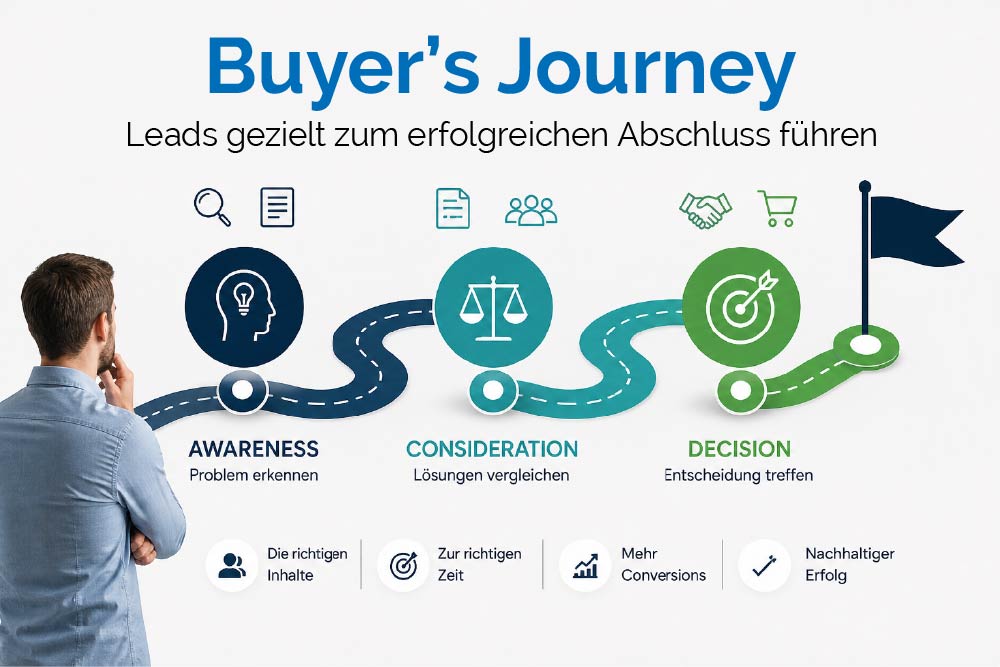
The buyer journey describes the path that potential customers take from the initial problem identification to the purchase decision. It typically comprises three phases: Awareness (recognize problem), Consideration (compare solutions) and Decision (select provider). It is crucial for companies because purchasing decisions are rarely made spontaneously, but rather from a sequence of information and evaluation processes. Understanding these steps and providing targeted support with suitable content and touchpoints increases the likelihood of prospective customers actually becoming paying customers.
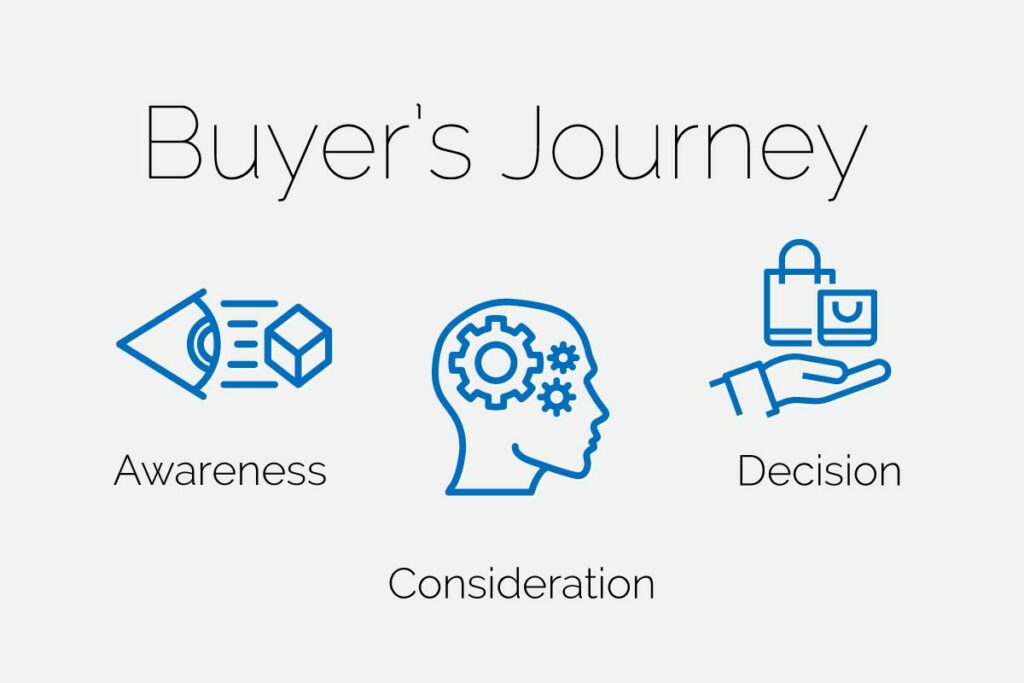
Table of Contents
The buyer’s journey maps the entire “journey” that your leads take from the first interaction (e.g. on the website) to a satisfied customer. Planned, in a structured way and with a strategic focus. The buyer journey is therefore the foundation of the entire lead generation.
What is the Buyer's Journey?
The Buyer’s Journey is the process that customers go through before they buy a product or service.
The path consists of three sections:
- the consciousness phase,
- the consideration phase and
- the decision phase.

You can draw qualified leads from all three phases!
Awareness Stage

In the awareness phase, potential customers (“leads”) become aware of a problem, a need or an opportunity and decide whether they want to prioritize it. They Google the problem at hand, look around on various social media channels or ask friends for advice.
What do you need to do?
It is important to provide potential customers with helpful information at this stage and to answer any questions they may have at this stage. This is not yet about sales communication, but purely about raising awareness and creating trust. You can position yourself here as an expert in your industry. This helps when potential customers move on to the next stage, as they will already know about your company and can come back to it.
Three questions you can ask yourself here:
- How would customers describe their problems?
- How do customers get information?
- How can you help customers get helpful information?
- What useful (online) content can you create?
Consideration Stage

During the consideration phase, interested parties (“prospects”) recognized their problem and decided to become active. In this phase, they look at all potential options and weigh which might be the right solution or product. They gather information, research potential providers and compare them. Under certain circumstances, contact is already made with companies here in order to obtain further information.
What do you need to do?
Here it is important to draw attention to your offer – for example through a Google search ad or organic search hits on your landing page with coordinated content. Also, consider what information prospects need to evaluate your product and provide it in as manageable a way as possible.
Three questions you can ask yourself here:
- What options are your customers considering?
- What criteria do customers use to evaluate the available options?
- How can I make customers aware of my offer and educate them?
Decision Stage

In the decision phase, interested parties have decided in favor of your solution – interested parties become customers. Up to this point, customers must be carefully accompanied. The inbound methodology offers good opportunities to precisely address the specific needs of customers.
What do you need to do?
They know all the pros and cons of your product and will make their decision based on that information. Here, it is a matter of responding precisely to the specific needs and, at best, personalizing them as much as possible. You should also use various tools – e.g. testimonials or webinars – to further build credibility and trust.
Three questions you can ask yourself here:
- Who will be involved in the decision-making process?
- What help do customers need at this stage and when buying the product/service? (e.g. training courses)
- How can I help customers close the deal smoothly?
Which content works in which phase of the buyer journey?
In order to guide leads through the buyer journey in a targeted manner, content must be clearly tailored to the respective phase. The decisive factor is not the amount of content, but the accuracy with which it matches the user’s intention.
Awareness phase (recognizing the problem):
In this phase, users are looking for orientation and basic information. Blog articles, guides or checklists that categorize a problem in an understandable way and show initial solutions are suitable. The aim is to attract attention and build trust.
Consideration phase (compare solutions):
This is where potential customers evaluate different options. Content such as comparative articles, case studies, white papers or webinars help to highlight differences and position your own solution. The aim is to qualify the lead and shortlist them.
Decision phase (making a decision):
The final phase is all about concrete purchase arguments. Demos, consultations, offers or references reduce uncertainty and create confidence in the final decision. The goal is to close the deal.
What typical mistakes happen in the buyer journey?
Many companies lose leads not because of a lack of visibility, but due to structural errors along the buyer journey.
A common mistake is to focus on sales too early. Users are already confronted with offers in the awareness phase, even though they have not yet built up a clear awareness of the problem or trust. This leads to abandonment.
Incorrect content allocation is just as problematic. General blog content in later phases or content that is too complex in the early phase slows down the decision-making process instead of supporting it.
Another weak point is the lack of connection between individual touchpoints. If content does not build on each other logically or does not provide a clear next action, leads are lost in the process.
How do you lead leads from one phase to the next?
The decisive lever in the buyer journey lies not only in the individual phases, but also in the transitions between them. It is precisely here that it is decided whether interest turns into a concrete intention to buy.
The transition from awareness to consideration is successful when users are offered targeted in-depth content after initial information – such as further guides, comparative content or specific solutions. It is important to clearly develop the content further, not just offer more of the same.
The change from the consideration to the decision phase requires trust and clarity. This is where concrete offers such as demos, advice or individual solutions that answer open questions and reduce objections work.
It is crucial that each phase specifies a logical next action. Without a clear continuation, leads remain in one phase or break off the process.
Where does a long sales cycle really start?
A long sales cycle rarely occurs by chance, but almost always due to clear bottlenecks in the decision-making process. In practice, the problem is usually not at the beginning of the buyer journey, but in the middle or late phase.
A typical bottleneck is the consideration phase: interested parties have recognized the problem but are unsure which solution is the right one. If there are no clear comparisons, concrete use cases or comprehensible results, the decision is significantly delayed.
Another critical point is the decision phase. In the B2B environment, there are often several people involved who have different requirements. If content or offers do not address all the relevant questions, internal coordination occurs – and delays result.
It is therefore crucial not to optimize the entire buyer’s journey across the board, but to specifically identify the phase in which leads “get stuck”. This is precisely where the greatest leverage for shortening the sales cycle lies.
The most effective levers for shortening the sales cycle
A shorter sales cycle is not achieved by taking more measures, but by using the right levers in the right places.
A key lever is the quality of the leads. The better a lead fits the target group and the more clearly the problem is defined, the faster the decision-making process will be. Unqualified leads often prolong the sales cycle considerably.
Reducing uncertainty is just as important. In the consideration and decision phase, decisions are delayed in particular if information is lacking or risks cannot be clearly assessed. Case studies, concrete results and transparent comparisons accelerate this process.
Another lever is clear guidance through the process. Leads should know at all times what the next sensible step is – be it further content, a conversation or a concrete offer. If this guidance is missing, there will be delays or abandonment.
Finally, internal coordination on the customer side also plays a role. Content that addresses several stakeholders at the same time reduces the coordination effort and shortens the decision-making time.
Typical mistakes that prolong the sales cycle
Many companies unconsciously extend their sales cycle due to structural errors along the buyer journey.
A common mistake is the incorrect prioritization of measures. Instead of specifically eliminating bottlenecks, content or campaigns are rolled out broadly without a clear reference to the respective phase. This leads to more complexity, but not to faster decisions.
Another mistake is the inadequate qualification of leads. If sales and marketing do not clearly define which leads are actually relevant, resources flow into contacts that are not ready to buy. This prolongs the entire process.
A lack of clarity in communication is also problematic. Unclear offers, vague promises of benefits or overly complex content lead to decisions being delayed.
Last but not least, the importance of coordination between marketing and sales is often underestimated. If the two areas send out different signals or are not coordinated with each other, this creates friction in the process – and therefore a longer sales cycle.
Customization of the buyer's journey
Of course, the Buyer’s Journey strategy and, deeply interwoven with it, the content strategy, must be adapted individually for each company. Each product requires a customized strategy and for each target group different measures are target-oriented. This means that many different factors have to be taken into account when considering the buyer’s journey.
If you are currently having problems acquiring new leads, we will be happy to advise you and help you reach your potential customers in the best possible way.
Frequently asked questions about the Buyer's Journey
What is the buyer journey?
The buyer journey describes the process that potential customers go through from the initial problem identification to the purchase decision. It shows which information needs exist in each phase and helps companies to tailor content and measures to these needs.
What phases does the buyer journey comprise?
The buyer journey usually consists of three phases: In the awareness phase, the user recognizes a problem, in the consideration phase he compares possible solutions, and in the decision phase he makes a concrete purchase decision. Each phase requires different content and approach.
How do you successfully guide leads through the buyer journey?
Leads are successfully guided through the buyer journey when content, offers and call-to-actions are precisely tailored to the respective phase. It is crucial neither to push users to buy too early nor to lose them with general information in later phases.
Why is the buyer journey important for sales?
The buyer journey is important because purchasing decisions are rarely made spontaneously. Companies that understand the decision-making process can build trust and address objections at an early stage, which significantly increases the likelihood of closing the deal.
What content works in the individual phases of the buyer journey?
In the awareness phase, informative content such as blog articles or guides are particularly effective. In the consideration phase, comparative content, case studies or white papers are effective. In the decision phase, concrete offers, demos or personal advice are convincing.
How can the sales cycle in B2B be shortened in concrete terms?
A shorter sales cycle is primarily the result of identifying bottlenecks in the decision-making process. These are often in the consideration or decision phase, where uncertainty or a lack of information delays decisions. Companies should use targeted content and measures to remove precisely these blockages.
What role does the buyer journey play in shortening the sales cycle?
The buyer journey shows what information potential customers need at each stage. If content and touchpoints are precisely tailored to these needs, uncertainties can be resolved more quickly and decisions accelerated.
Which mistakes most often prolong the sales cycle?
The most common mistakes include unqualified leads, a lack of coordination between marketing and sales and content that does not fit the respective phase. These factors lead to prospective customers staying longer in the decision-making process or dropping out.