Value-Based Bidding in B2B: Optimizing Google Ads with HubSpot
How Does Value-Based Bidding Work in B2B with HubSpot?
Value-Based Bidding (VBB) in B2B links Google Ads with HubSpot CRM data to optimize bids based on actual business value rather than conversion numbers alone. By combining early-stage lead scoring upon form submission with the reporting of offline conversions (MQL, SQL, Opportunity, Closed Won), Google Ads receives nuanced quality signals—even with low lead volumes and long sales cycles.
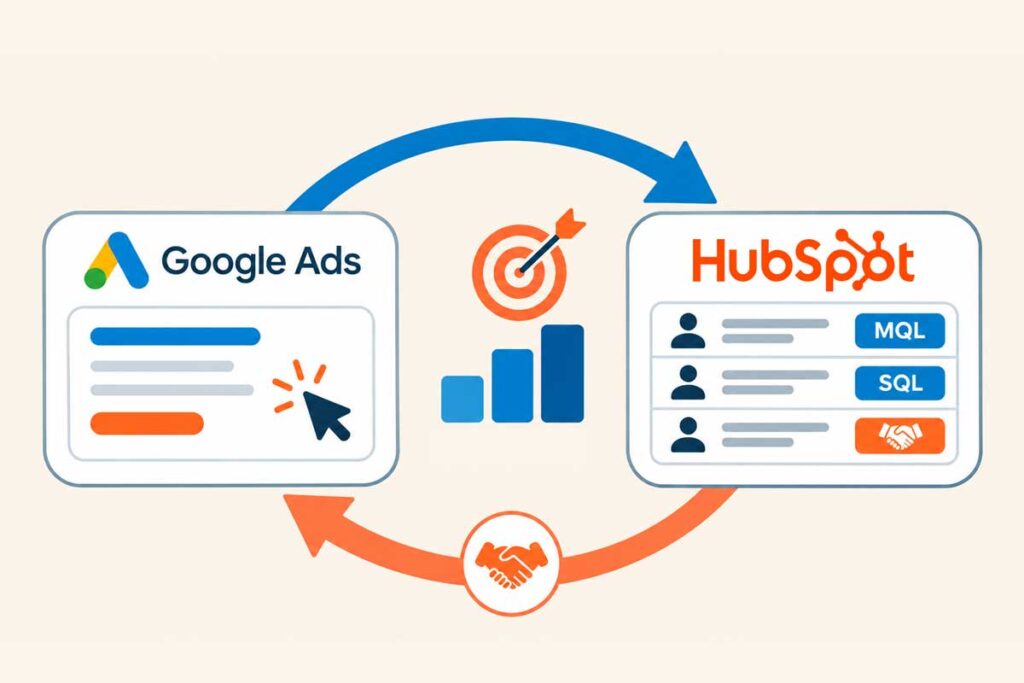
Table of Contents
1. Convey quality signals early on: Lead scoring upon form submission
- Firmographic characteristics: Company size , industry, region, or other attributes that align with the Ideal Customer Profile (ICP).
- Purchase Intent: A specific request for a demo or contact often indicates a higher level of purchase intent than a non-binding content download.
- Historical CRM data: Based on experience, which lead types are most likely to develop into opportunities or customers?
A score is calculated based on this information, which is then translated into an estimated monetary conversion value.
It is crucial that these values are not assigned arbitrarily. They should, as much as possible, reflect the expected economic contribution of a lead.
A simplified example:
A lead with an estimated probability of closing of 10% and an expected deal value of €10,000 would have a calculated expected value of €1,000.
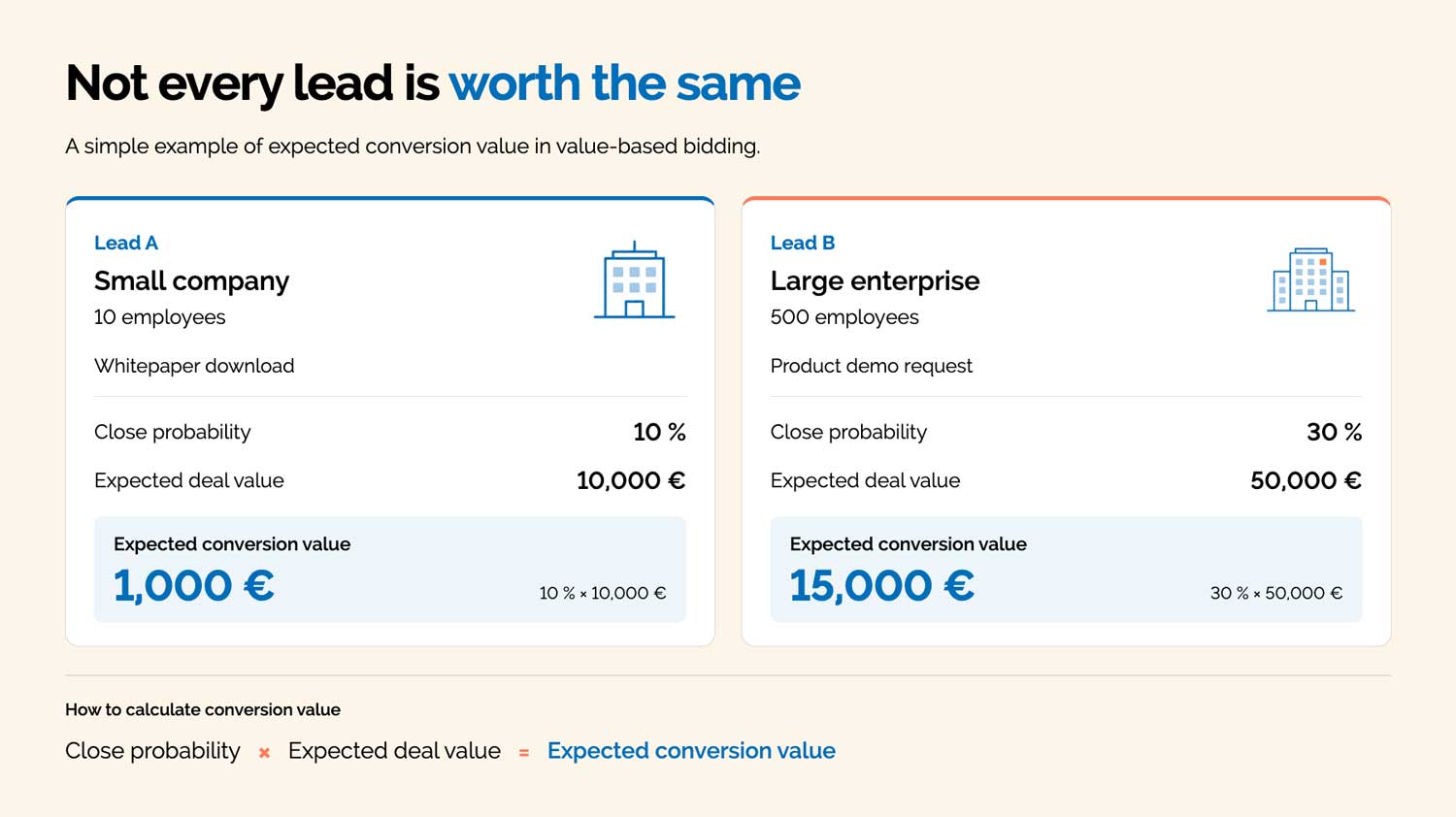
Depending on the business model, it may make more sense to use the expected contribution margin rather than revenue.
The key advantage: Google Ads receives a detailed quality signal immediately after the form is submitted, without having to wait for subsequent qualification by the sales team. For this approach to work, the calculated value must be passed to Google Ads along with the conversion when the form is submitted. Lead scoring in HubSpot alone is not sufficient for this.
It is important to distinguish between the calculation of the score in HubSpot and its technical transmission to Google Ads. The native integration can synchronize certain conversion events and their values. However, a custom-calculated, dynamic lead value cannot be automatically transferred in every desired scenario without additional configuration or a technical connection.
2. Using HubSpot as a Source of Feedback: From MQL to SQL
An automated lead score is an initial assessment. However, whether a contact is actually relevant often becomes clear only after it has been qualified by the sales team.
As soon as a Marketing Qualified Lead (MQL) is reviewed in HubSpot and classified as a Sales Qualified Lead (SQL), additional information becomes available.
This includes, for example:
- Is there a specific need?
- Is there a realistic budget?
- Is there a current project or a clear timeline?
- Is the company actually a good fit for the product or service being offered?
This information allows for a more accurate assessment of the lead.
If a contact is classified as an SQL, an additional conversion event can be triggered in HubSpot and sent to Google Ads with a correspondingly higher value.How does the information get back to Google Ads?Through the HubSpot and Google Ads integration—or a corresponding technical connection—CRM events can be sent back as offline conversions.HubSpot supports this, among other things, through conversion events based on changes in the lifecycle stage. Depending on your requirements, custom integrations or the Google Ads Data Manager may also be useful.
This way, Google Ads not only receives the information that a form was filled out, but also which of these contacts were later classified as qualified by the sales team.
By using Enhanced Conversions for Leads, hashed first-party data (such as email addresses or phone numbers) and the Google Click ID (GCLID) are securely transmitted from the CRM to Google Ads. This enables precise attribution of offline conversions to the original ad interaction, even when cookies are restricted or the qualification process occurs at a later time.
This creates a feedback loop between marketing and sales: Insights from HubSpot feed back into the optimization of Google Ads campaigns.
3. Consider the entire sales funnel: Opportunities and Closed Won
Ideally, the data flow should not end with SQL qualification. The further a lead progresses through the sales process, the more information becomes available about its actual business value. This information can also be transmitted to Google Ads.
Opportunity Stage
If an SQL develops into a concrete sales opportunity, a deal is created or appropriately qualified in HubSpot. At this point, an expected deal value and an estimated probability of closing are often available. Based on this, a weighted pipeline value can be calculated, which can be passed on to Google Ads as an additional conversion signal.
Closed Won
As soon as a deal is successfully closed, the actual contract value is determined. This value can also be reported to Google Ads as an additional conversion event, provided the conversion still falls within the supported attribution window. This allows campaigns to be evaluated not only based on generated leads but increasingly also based on their actual pipeline and revenue contributions.
Why use multiple funnel stages as conversion goals?
In B2B in particular, conversion volumes are often low. While e-commerce companies can record numerous purchases every day, B2B often generates only a few SQLs, opportunities, or closed deals per month. If you optimize Google Ads exclusively for these late-funnel stages, you may be providing the algorithm with too few signals for reliable bid optimization.
One possible approach, therefore, is to use multiple funnel stages as primary conversion goals and assign them different monetary values. This way , Google Ads takes into account both the more frequent early conversions and the less frequent but more financially valuable events from the sales process.
A simplified example
| Funnel Stage | Additional conversion value |
| MQL | 100 € |
| SQL | +400 € |
| Opportunity | +1,500 € |
| Closed Won | +€8,000 |
The values are purely fictional and are provided for illustrative purposes. In this example, a lead that progresses through all four stages generates a total conversion value of €10,000. It is important that the values are aligned with one another. Since a single lead can pass through multiple funnel stages, the conversion values add up when all relevant events are taken into account for bid optimization.
The additional values should therefore be defined in such a way that the overall valuation reflects the expected economic contribution of a lead as realistically as possible. Otherwise, there is a risk of artificially inflating the actual pipeline value.
This multi-step approach does not guarantee better results. However, it offers a way to incorporate various quality and value signals into bid optimization, even with lower B2B conversion volumes.
4. Take into account long sales cycles and delays in conversion
Another challenge in B2B marketing is the time lag between lead generation and actual business success. For example, a prospect might request a demo today, be qualified as an SQL three weeks later, and become a customer several months down the line. For Google Ads, this means that particularly valuable conversion signals sometimes arrive with a significant delay.
Added to this are technical limitations: Offline conversions can only be attributed to the original ad interactions within specific time windows. With Enhanced Conversions for Leads, for example, the import window is 63 days after the corresponding ad click.
Especially with longer B2B sales cycles, closed deals may therefore no longer be importable into Google Ads as attributable conversions. This makes it all the more important to provide meaningful data early in the funnel. The combination of immediate lead scoring and subsequent CRM feedback makes it possible to use early quality signals for bid optimization and supplement them with additional information from the sales team.
These delays must also be taken into account when evaluating campaign performance. A campaign that generates many leads today may not show its actual contribution to the pipeline until weeks later. Therefore, in addition to the immediate Google Ads results, you should also analyze the development of leads in HubSpot and the resulting opportunities and revenue.
5. When Is Value-Based Bidding Worth It in B2B?
Value-Based Bidding can be particularly useful when leads have very different business potentials.
This is often the case in B2B: A demo request from a small business may have a completely different expected business value than a request from an international corporation. At the same time , qualified conversions are often rare, so optimizing exclusively for opportunities or closed deals can be difficult.
The multi-stage approach aims to combine these two challenges: early, more frequent conversion signals and later, more meaningful information about the actual lead quality.
For this to work, however, certain prerequisites must be met:
- Reliable CRM data: The relevant funnel stages must be consistently maintained in HubSpot.
- Transparent lead scoring: The assigned scores should be based on realistic closing probabilities and expected deal sizes.
- Accurate data transmission: Conversion events and their values must be correctly transmitted to Google Ads.
- Sufficient data foundation: Even multiple funnel stages cannot arbitrarily compensate for a lack of conversion volume. The volume and quality of the data must be sufficient for meaningful optimization.
If these prerequisites are met, a value-based bidding strategy such as Maximize Conversion Value can be tested with or without a target ROAS.
The switch should not be evaluated solely based on the number of leads generated.
The key factor is whether the advertising budget actually generates more qualified leads, high-value opportunities, and, ultimately, more revenue.
6. Implementing Value-Based Bidding with HubSpot: A Practical Checklist
Before you switch your Google Ads campaigns to value-based bidding, you should follow these steps:
- Review conversion goals: Which events are currently being tracked in Google Ads and used for bidding?
- Define lead quality: What criteria does the sales team use to identify a qualified lead?
- Review the HubSpot data model: Are lifecycle stages, leads, and deals consistently maintained?
- Develop conversion values: Can realistic economic values be derived from historical CRM data?
- Set up data transfer: Which events can be synchronized via the native HubSpot integration, and where is an additional technical solution required?
- Review data protection: Have the required consents and consent signals been properly accounted for?
- Test the bidding strategy: Selectan appropriate primary conversion stage, review data quality and conversion volume, and conduct controlled testing of the value-based strategy.
- Evaluate Results: Don’t just look at CPL and conversion value—also consider the SQL rate, opportunity growth, and actual revenue contribution.
It’s especially important not to change all conversion goals, value models, and bidding strategies at the same time. Otherwise, it will be difficult to determine later which adjustment affected the results.
Conclusion: Fewer low-value leads, more economic value:
In B2B marketing, not every lead is equally valuable. Nevertheless, Google Ads campaigns are still frequently evaluated and optimized based on lead volume and cost per lead. Yet the key information about actual lead quality is often already available in HubSpot.
Value-Based Bidding offers the ability to use this information specifically for bid optimization. By combining early lead scoring with continuous feedback of MQL, SQL, opportunity, and closed-won data, Google Ads receives more nuanced signals about the business value of individual leads.
Especially with low conversion volumes and long sales cycles, a multi-stage value model can be a sensible alternative to optimizing exclusively for closed deals.
The goal is not to generate as many leads as possible at the lowest price, but rather to focus the existing advertising budget more on prospects who actually have the potential to become valuable customers.
Get Started with Value-Based Bidding Using Google Ads & HubSpot
Would you like to align your Google Ads bids with real business value or optimize your HubSpot integration for value-based bidding? We’ll help you define your lead scoring, seamlessly sync offline conversions, and maximize the potential of your advertising budgets.
Frequently Asked Questions About HubSpot and Google Ads
What's the best way to transfer HubSpot data to Google Ads?
Data can be transferred either through the direct HubSpot-Google Ads integration, through Enhanced Conversions for Leads using hashed first-party data, or by importing offline conversions via GCLID.
At what conversion volume does value-based bidding become worthwhile in B2B?
Google officially recommends the following for value-based bidding strategies (such as Target ROAS / Target ROAS), a minimum volume of at least 15 conversions in the last 30 days at the conversion tracking level. Since B2B companies often generate only a few deals per month, it’s advisable to use multiple stages of the funnel (e.g., form submission, SQL, opportunity) as conversion events to provide sufficient data signals for Smart Bidding.
What should you do if the sales cycle is longer than the Google Ads attribution window?
If the final purchase occurs outside the time window (e.g., 63 days for offline conversions), you should primarily optimize for upstream quality signals such as lead scores at form submission, as well as SQL and opportunity stages.
Which Google Ads bidding strategy is best suited for value-based bidding?
As soon as valid conversion values are reported, the “Maximize Conversion Value” strategy—optionally combined with a target ROAS (tROAS)—is a good choice for targeting the advertising budget toward the most valuable leads.
What is the difference between lead scoring and value-based bidding?
Lead scoring evaluates the quality of a lead or its likelihood of making a purchase. Value-based bidding uses monetary conversion values for automated bid optimization in Google Ads. A lead score can serve as the basis for a conversion value, but it must be converted accordingly and submitted to Google Ads.